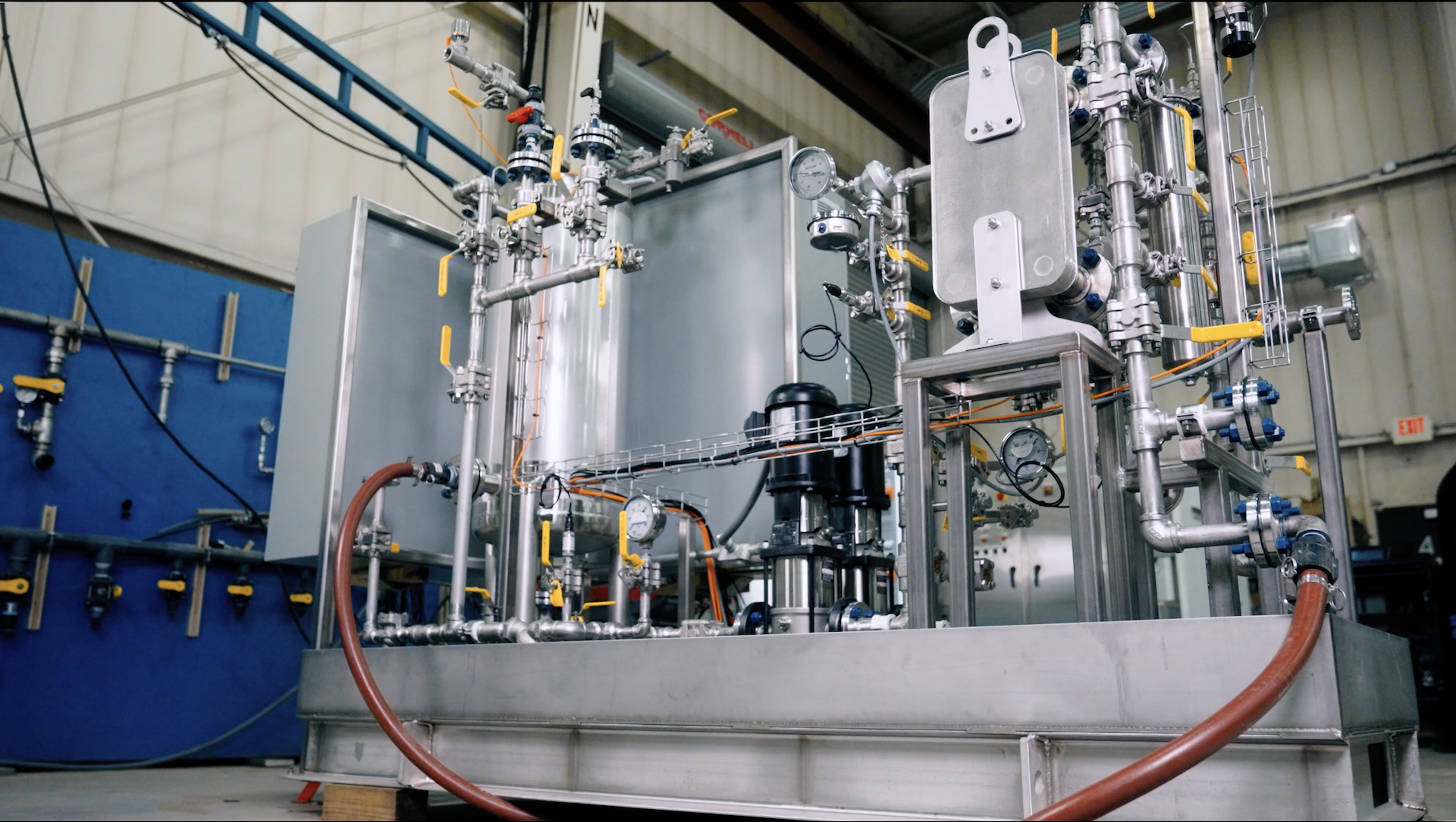
Most skid projects don’t start with a finished drawing. They start with a rough idea and a list of requirements, and someone has to close the gap between the two. When Fermilab needed a custom cooling skid for its PIP-II accelerator upgrade, that gap is exactly what they handed us: a one-page concept sketch and a 19-page spec. Here’s how it became a shipped, tested system.
What a custom cooling skid actually is
A cooling skid is a self-contained system that moves heat away from a process and keeps a temperature steady. Pumps, a heat exchanger, valves, instrumentation, and controls are all mounted on a single steel frame, wired and piped as one unit. It ships assembled, so the customer installs one skid instead of building a system from loose parts on site.
For Fermilab, the job was specific. When the particle accelerator is safely shut down, the beam is diverted into a graphite block that absorbs its energy. Our custom cooling skid circulates water around that block and regulates its temperature. The physics is theirs. Keeping it cool is ours.
Why the “concept-to-finished” gap matters
A spec sheet tells you what the system has to do. It doesn’t tell you how to fit it together. Fermilab’s concept sketch gave us a starting point and a set of hard numbers — the finished skid had to stay inside 32 inches deep, 79 inches tall, and 92 inches long. Those dimensions were helpful, and they were a tight constraint to design around.
The risk in any project like this is that the finished system drifts from what the customer actually needs, or that it meets the spec on paper but is a headache to install and maintain. On a system that supports a national research facility, neither outcome is acceptable. That’s why the process matters as much as the parts.
The constraints we designed around
A few requirements shaped every decision on this custom cooling skid:
- The envelope. Everything had to fit inside a fixed footprint, with lifting lugs and forklift slots for moving it.
- Maintainability. Major components — pumps, flow meters, transducers — had to be replaceable without removing piping or draining the system. That drives layout, not just part selection.
- Materials and code. Wetted parts in 304/304L stainless and compatible seals, piping built and pressure-tested to ASME B31.3, and an ASME Section VIII tank.
- Controls. A UL 508A control cabinet running a PLC and HMI — on a software platform we hadn’t used before.
How the design came together
Our CAD operator, Kermith Bilbao, started with the P&ID and the concept sketch and built a first layout that closely matched what Fermilab sent over. Then he sent it back to project engineer Steven Barach and to Fermilab for feedback. A lot changed once the exact instrumentation was chosen and the tank was purchased from a vendor — real components have real dimensions, and the model had to catch up to them.
As Kermith put it, “it was an iterative process with Steven and the customer to get it right.” That back-and-forth is the work. The concept sketch got ASI in the door; the rounds of review are what turned it into a system that fits, installs, and holds up.
What ASI does differently
Every part of this custom cooling skid was built in-house in Aurora, Illinois — mechanical design, stainless fabrication and welding, electrical panels, controls, and the final functional test. That means one team owns the whole system, and problems get solved in one building instead of across three vendors.
The controls were the new wrinkle. Fermilab uses a specific platform, Productivity Suite, to interface with systems like ours, and we hadn’t worked with it. So our associate electrical engineer, Oscar Mendoza, spent more than three weeks learning it for this project. Nobody asked us to bill for that. That’s what a good partner does.
When it came time to test, Fermilab brought a team of engineers out to our facility to see the skid run before it shipped. It left fully assembled and fully tested, ready to install.
Why they came back
This wasn’t our first project with Fermilab. We’d done smaller work for them before, and they liked how it went. When they were ready for something more complex, they came back. One of their engineers summed it up during that visit: they could hand us a rough sketch or a detailed drawing, and they knew we’d see it through to a finished product. That kind of trust isn’t given. It’s earned, one project at a time.
See the FInished Product Here
Frequently asked questions
What does the timeline look like on a custom skid project?
It starts with drawing delivery and customer approval, including any revisions. Once drawings are approved, procurement begins — and it can sometimes be advanced by approving major components that won’t change ahead of the full drawing set. After materials arrive, we build, test, ship, and deliver final documentation.
Can you add instruments or components to a skid?
Yes. Instrumentation and component choices are part of the design conversation. On the Fermilab skid, much of the layout was finalized once exact instruments were selected, which is a normal part of the iterative process.
Are systems tested in-house before they ship?
Yes. Fabrication, welding, and a final functional test all happen under one roof, and customers are welcome to witness testing before shipment — as Fermilab’s engineering team did on this project.
What documentation comes with the system?
Standard documentation includes as-built drawings, mechanical and electrical drawings, manufacturer IOMs, datasheets and part numbers, and material test reports (MTRs), plus any project-specific documents the job requires.
What’s included in an AmeriChem scope of supply?
We supply what’s inside the boundary of the skid or P&ID — the system itself. Interconnecting pipe and wiring outside those limits are typically handled by others unless specified.
Talk to us about your system
Need help scoping a system? Schedule a quick design call with our team. Call +1 630 495 9300 or email inquiries@americhemsystems.com.